Showing posts with label natural wines. Show all posts

Wednesday, 25 February 2015

Natural Wine: 2 Winery Visits

My recent reading of Isabelle Legeron's book, Natural Wine, inspired me to visit a couple of the California producers she recommends. The term "natural wine" attracts a lot of controversy, but it is a nebulous one, meaning whatever its supporters or detractors wish. Therefore, I wasn't that surprised that my two visits did not help me form any conclusions on what natural wine is or is supposed to be - instead, it hardened my belief that natural wine is impossible to categorise. However, I was pleasantly surprised at just how good the wines of the two wineries were, especially as they were in areas of California that don't attract attention for quality wine. The other thing the two had in common was the beauty and isolation of their wineries.

a dog and ducks: what every winery needs


La Clarine

Located on the edge of the Eldorado National Forest (nearly a three-hour drive from Napa), the farm at La Clarine has about a hectare of vines planted, with the rest of the grapes bought in from neighbouring vineyards. It's run by Hank Beckmeyer, who worked in the music business with his French wife but got out before the industry could make him "into too big of an asshole." The two of them fell in love with wine on business trips to Provence, making their first wine in a flat in Hamburg. They bought this property in 2001, with the aim not of making wine but cheese. Although there are plenty of goats still grazing on the farm, they abandoned the cheesemaking project after three years because it was too hard and expensive to produce commercially.

Hank is reassuringly unphilosophical about his winemaking. I asked him what inspired him to make wine, and received a one-word answer: "drinking." He admits he learnt winemaking on the go, and his way of making wine was motivated by a desire "to do as little as possible - only what's necessary," as he gradually concluded that most winemakers indulge in too much intervention. For him, the aim seems to be not to make "natural wine," but to find the answer to the question: "how far back can you take" the winemaking process? Is it possible to fulfil the "goal" of doing "absolutely nothing"?

Despite that goal, there is a definite methodology to his practices. The black grapes are crushed by foot and fermented in the "ambient temperatures" outdoors, while the whites are fermented indoors where fermentation can take six months. Sulphur is not used except in bottling, "as you just don't know what will happen" when the bottle reaches the consumer. There's no filtering or fining.

La Clarine make 2,000 cases a year, distributed to Los Angeles, San Francisco, and New York, as well as Chicago and Boston. They have also just started distributing to Australia. Hank's distribution policy is simple and one I would follow: sell the wine where he and his wife want to visit.

the wines

visiting in February, most of the wines I tasted were still in barrel

2014 Jamabalaia White

An anarchic blend of Viognier, Marsanne, Roussanne, Petit Manseng, Arneis, and Fiano, this is a wine that Hank has been playing around with over the years, experimenting with skin contact, different sites, and grape varieties as they become available. This is an appealing, edgy wine with lots of complexity. As good as it was, however, there was clearly a "natural" aspect to it: it was very nutty, with some oxidation, and a slight sherry nose. For me, that just added to the appeal, but for most drinkers that would be an issue. Hank's take was that most drinkers seeking out his wine expect some funkiness on the nose or a haziness in the glass, but anyone coming to the wine knowing nothing about it would likely to be troubled - something he seemed quite relaxed about.

2014 Counoise Rosé

Oak is too much of an intervention between grape and bottle, so almost none of La Clarine's wines are aged in oak, either new or old. However, the one wine that is aged in oak is the style that usually least sees oak: rosé. Both fermented and matured in old oak barrels, this rosé is a surprisingly pale golden colour, with a  yeasty nose, but with a balanced creamy texture: a very interesting wine that I'd like to taste once it was ready to be bottled.

2013 Syrah Sumu Kawr ($28)

The one wine I tasted from bottle, this is a superb raw expression of Syrah - a grape that the rest of California has trouble figuring out. The name of the wine means "place of the summer pines" - there's a pine tree in the middle of the vineyard. There's no new oak: the tannins come from whole cluster fermentation. Wild and bitter, the wine has intense black fruits, black pepper, and liquorice aromas, with a strange but enticing bark and quinine element. The wine is different, intense, but compelling, and one that will age well for many years.

Clos Saron

Nearly another three hours north of La Clarine lies Clos Saron, in the Sierra Nevada foothills. The winemaker here is Gideon Beinstock, a French-Israeli who became captivated by wine when living in Paris in the late 1970s. Then an artist, he became friends with Steven Spurrier as well as taking the opportunity to visit some of the best wineries in France.

A softly-spoken, engaging character, Gideon is at pains to express his discomfort with the concept of natural wine, which he describes as controversial and ambiguous. Most interestingly, he criticises natural wine as being "low in terroir" as winemakers are too interested in the winemaking methodology rather than the soils, grapes, and climate that produce the taste of wine. He told me that the way he makes wine has nothing to do with philosophy, but about how the wine tastes. Like Hank at La Clarine, he believes in stripping the winemaking process as far back as possible so that the wine expresses the grapes and soil it came from. He does, however, spray some sulphur on the vines - "about a third of what is normal" - and the wines are aged in old oak barrels.

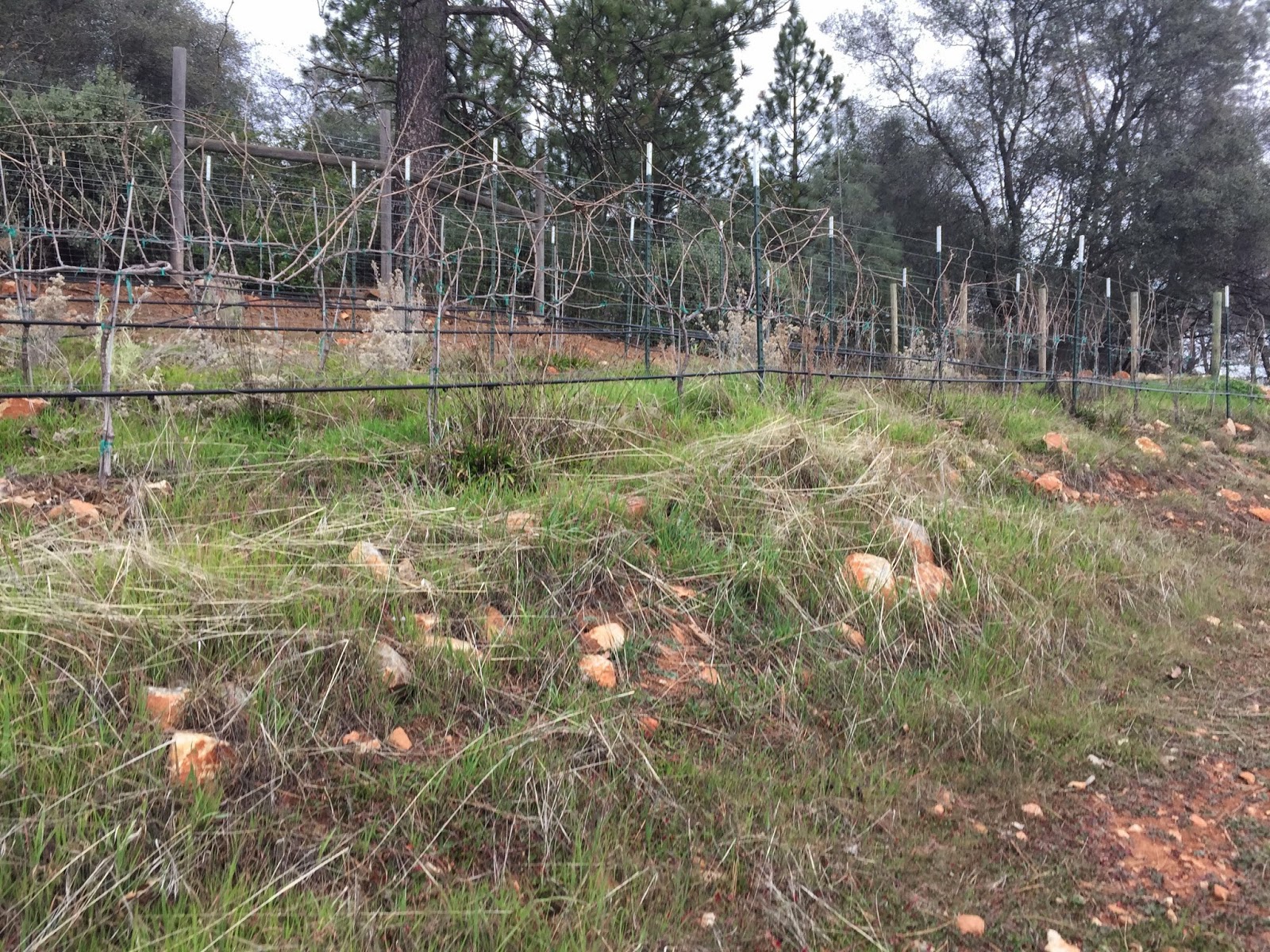
The plantings at Clos Saron are small, though undergoing expansion. The new, young vines take time to develop as they are ungrafted - therefore not receiving the high vigour of American rootstocks - and the phylloxera-free soil is difficult and infertile. Despite this and the ongoing drought, the young vines are watered just four times a year, while the older Pinot Noir vines from the 1970s haven't been watered in four years. With sheep grazing in the vineyards and ducks, geese, rabbits, and vegetables serving as food, Clos Saron is a largely self-sustaining farm - Gideon may be sceptical of the notion of the natural wine, but it's no surprise that supporters of the movement have tried to herald him as a leading light.

the wines

2014 Stone Soup Vineyard Syrah
young Viognier vines
From eleven-year-old vines planted on a steep, difficult, rocky southern-facing slope exposed to the sun, I feel this is one of those rare wines that will over time compare to the great wines of northern Rhône. Viognier vines have also been planted in the same vineyard, which will begin to be co-fermented with the Syrah. The vineyard is still a work in progress but the wine is one to watch out for: an intense perfume with great, dry, gripping tannins, and a winning combination of power and finesse.

2011 Old Block Pinot Noir ($75)

From ungrafted, phylloxera-free vines is Clos Saron's most intense, expressive, and developed wine. It's a young and intense, earthy wine, with wild strawberries on the nose. It has a beautiful mouthfeel, with elegant dry tannins and complex red berry fruits, flowers, pepper, and spices. A difficult wine that may take some years to express itself fully, but one whose intensity and closed structure mark it out from even many of the other best Californian Pinots.

the thick vines are older, from the 1970s; the thinner ones from the 1990s

As at any winery, tasting the wines from these two producers was a mixed bag (especially as so many of them were still in the barrel developing), but constant throughout was a willingness to experiment and a profound ambition to express the nature of the land. There was also a healthy scepticism towards the idea of natural as well as commercial wine: these were two winemakers doing their own thing rather than following any movement.

I think as the wines age, the differences between them and more standard wines will become less noticeable - instead the character of the wines, rather than the winemaking philosophy, will express itself further. However, the lack of sulphites and general intervention may cause difficulties: Gideon admitted that his wines had not shown well in France and the UK unless they had been given a month to settle. These are sometimes difficult and particular wines but ones that deserve respect - no less than any wine should. 

Thursday, 5 February 2015

Globalisation, nature, and trade: Wine & Books

The Judgment of Paris: California vs. France and the Historic 1976 Paris Tasting that Revolutionized Wine by George M. Taber

Having watched the wildly inaccurate Bottle Shock, I had to read a more authentic and reliable account of the famous "Judgment of Paris" tasting. George Taber was the only journalist present at the legendary event, and so is ideally placed to give his take on what actually happened. The Paris Tasting was one of many such contests between Californian and French wine that took place during the 1970s, but the tasting was in Paris and featured some of France's leading members of the wine industry, including Robert Drouhin of Burgundy's leading négociant Joseph Drouhin, Aubert de Villaine of Burgundy's most exclusive winery Domaine de la Romanée-Conti, and Odette Kahn of La Revue du Vin de France. California came out on top: Chateau Montelena's 1973 Chardonnay won, by some distance, the morning's tasting of white wines, while Stag's Leap's 1973 Cabernet Sauvignon more narrowly won the tasting of Bordeauxesque reds.

Taber gives a reliable, if slightly one-sided, background to the event. A chapter each focuses on Steven Spurrier, a well-to-do young English wine merchant who organised the event, and a potted history of the wines of Bordeaux and Burgundy. Much of the spine of the book concentrates on the Californian wineries, producers, and winemakers who triumphed at the tasting: Jim Barrett, lawyer and co-owner of Montelena, Mike Grgich, their Croatian winemaker, and Warren Winiarski, owner of and winemaker at Stag's Leap, as well as the many people who laid the foundations of the Californian wine industry in the 1950s and 60s.

Taber peddles the American dream a little too relentlessly in these chapters: hard-working, honest Americans who achieved in less than twenty years what the French had spent two thousand working towards. All that knowledge the French had handed down from generation to generation was worthless: the Americans learnt it all in no time and did it even better. Grgich's European upbringing also becomes part of the fairy-tale: just look at what America allowed him to do that Croatia wouldn't have. Underneath this mythologising is the fact that the Californians looked towards and learnt much of what they knew from the French, using those thousands of years of knowledge to establish winemaking in nascent California.

Taber then awkwardly uses the Californian victory to herald the subsequent, glorious globalisation of wine. Fear not, Taber tells us, that wine made from ubiquitous grapes such as Sauvignon Blanc, Chardonnay, and Cabernet Sauvignon all taste the same no matter where they come from "because they make outstanding wine, and consumers enjoy them." Forget fusty Old World wines, drink ultraclean New World brands like Yellow Tail. Overlook the near collapse of the Napa wine industry in the 1980s due to phylloxera because growers and UC Davis professors refused to listen to the French. Ignore the advances in grape growing and winemaking introduced by the French over the last few decades, and instead dismiss French wine as on death's door (France still produces twice as much as the USA).

Moving away from the US, in Taber's eyes all this makes Cloudy Bay the ultimate success story, whose history he swallows unquestioningly. As revolutionary a taste as New Zealand's Sauvignon Blanc was when it was launched on the world in the 1980s, it's wrong to say that, "France's Sancerre ... lacks any personality and is often too acidic." Just as it's wrong to believe that "wineshops run out of their allocation a few weeks after [Cloudy Bay] arrives each spring" - there's plenty of Cloudy Bay (now owned by France's Moët-Hennessey) out there, it's just that it's dripped into the market to create a sense of scarcity. And it's ironic that Cloudy Bay has become what Taber accuses French wine of being: priced on reputation rather than quality.

Ending the book with a sweeping, one-dimensional appraisal of the globalisation of wine feels out of place in what is supposed to be an account of a 1976 tasting and the development of Californian wine. The follow-up tastings in 1986 and 2006 are referred to only as further evidence of California's superiority, rather than delving more deeply into how the wines, their producers, and indeed the rest of the Californian wine industry has developed in that time. In the end, Taber's book had the opposite effect of the Paris tasting: to drive me back to quirky, odd French wines he believes the New World has seen the back of.

Natural Wine: An Introduction to Organic and Biodynamic Wines Made Naturally by Isabelle Legeron

Which leads to a book that details a very different development in the world of wine over the last twenty years. The book is presented even more one-sidedly than Taber's, but with the passion of someone who fervently believes in a subject she knows inside out.

Natural wine is an ill-defined movement led by French and Italian winemakers reacting against the use of chemicals and sulphites in winemaking. The purpose of natural wine is to make wine that represents the purity of the land and the grape, with as little human interference as possible.

This a beautifully presented book, which passionately argues in favour of all natural wine - not just the ethics, but its superior quality too. The latter I am yet to be convinced about (Legeron lists natural wines she recommends at the end of the book, which I will be interested to try), but her arguments for natural winemaking (and farming in general) are persuasive and even invigorating.

It's certainly a welcome antidote to Taber's espousal of the homogeneous globalisation of wine, a reaction against what one natural winegrower, Tony Coturri of Sonoma, describes as "Over-ripened, then diluted with water, acidified and 'corrected,' this is the premium Napa product, sold at 100 bucks a bottle."

As well as Legeron's passionate defence of natural wine, the book features several first-hand accounts from winemakers describing not just their approach to winemaking but also other aspects of farming: plants, herbs, bread, cider, and horses. Although highly subjective, the book has an inspirational core: making wine and growing things is something everyone of us can do if we work with nature, just as we have been doing for thousands of years. Sadly, my subsequent attempts to make bread have thus far disproved this theory.

Madeira: The Mid-Atlantic Wine by Alex Liddell

Madeira was perhaps the first "New World" wine. A small, rocky, woody island colonised by the Portuguese in the 1400s, Madeira quickly became known for the quality of its wines, particularly from the Malvazia grape (known as Malvasia elsewhere). The development of its industry was based solely on trade with Portugal's and Britain's new American colonies. It was these long distances which led to Madeira's unique taste: the wine is fortified and then aged for many years at warm temperatures to mimic transatlantic journeys.

Sadly, Madeira is too small an island to sustain its own domestic wine industry and its wine economy has been displaced over the centuries by wines from around the world. The wine too, while being one of the world's greatest, is too quirky, individual, and different to compete with wines that are released at a much younger age.

This leaves the Madeira wine industry in a sorry state: vineyards at the bottom of cliffs with unidentified varieties planted alongside bananas and vegetables; plantings are still dominated by American varieties that aren't actually allowed into the wine; there are only seven exporters; and what market there is in the UK and the US dwindles each year.

Liddell's style is as old-fashioned, determined, and sometimes difficult as the island's best wines - and like the wines I doubt this is a book that will fly off the shelves. But the book exists for a very good reason: the wines have their addicts like me, and the wine's rich history, which is such a vital part of Madeira's culture as well as the development of global trade, needs to be recorded. And unlike with Chardonnay or Cabernet Sauvignon, Californian brands are never going to successfully replicate the island's great, long-lived wines.


In two forthcoming blogs, I will be looking more closely at some Californian natural wines and California's historic and continuing use of European place names for low-quality wines.

Thursday, 2 October 2014

Organic, Biodynamic, and Natural Wines

Little in the world of wine causes as much consternation, confusion, and controversy as organic, biodynamic, and natural wines. These are terms that are meant to point to a supposedly purer method of making - and sometimes drinking - wine, removed from industrial scale production. Yet the terms are often misleading, wrapped up in obscure language and arcane rules, causing opinions on both sides to be based on prejudice rather than information.

There is a clear, if perhaps unquantifiable, demand for wines which have been made with as little interference or environmental impact as possible - and there are plenty of wines that meet that demand. Yet few advertise their credentials, because the terms organic, biodynamic, or natural are either so precise that producers refuse to be constrained by the rules or because the terms are too imprecise to mean anything. 

Over the last few months, I've visited a number of Californian wineries who are understandably proud of their sustainable farming practices, yet refuse to label their wines in ways which would promote those practices. This is partly because each winery wants to do their own thing without having to follow exact rules, because there is too much bureaucracy to bother getting certified, and because many consumers are put off by terms such as organic and, especially, biodynamic as there is too little understanding about what they mean.
 

Organic

The aim of organic winemaking is to be environmentally conscious, by integrating winemaking practices with the surrounding ecosphere and avoiding the use of pesticides. Many of the principles should come naturally to any small or traditional producer - unfortunately those who often can't afford to wade through all the paperwork to label their wines organic. 

For a wine to be classed as organic, the winery must be certified by the International Federation of Organic Agriculture Movements, whose rules are enshrined in EU law. Rules are strict, and wineries have to annually apply for accreditation. Being next to a non-organic winery can be enough to prevent being accepted as organic and if a winery lapses from its organic status, it has to wait another seven years before it can apply again. 

Farming the same way as previous generations, many traditional European wineries are organic even if they are not certified as such, and over a quarter of Oregon's wineries follow sustainable farming practices. But it's almost impossible to tell if a wine is organic, or which organic principles a winery follows, because it makes so little financial sense for a winery to become officially organic. Despite so many wineries practising organic winemaking, there are less than 2,000 accredited around the world, many of them in France.  


vegetarian/vegan

This is perhaps the most specific element of a wine that customers most ask about, and it's the one easiest accounted for. It surprises me that wineries don't label their wines as such because it comes down to one simple thing: whether the fining used to clarify a wine is from egg whites (used in red wines) or fish bladder (for whites). The wine does not have to be organic to be vegetarian or vegan, though it probably helps. 

Biodynamic

Based on a system by the maverick thinker Rudolf Steiner, biodynamics is a combination of hocus-pocus and common sense. Notoriously, biodynamic practices include burying a cow's horn full of manure in a field; other strict rules include undertaking certain elements of farming only at specific times of the day or month "by considering all aspects of lunar cycles, solar cycles, star constellations and the movement of other planets," according to When Wine Tastes Best, a biodynamic, and beautifully presented, app which advises when you should or should not drink wine. 

This spiritual, holistic approach may be easy to mock, but the general principle of adhering to nature's cycles is a sensible one. Vines are plants which rely on the surrounding environment, so wineries will leave forests uncultivated next to vineyards, plant fruit trees and keep bees, which are vital conduits in the ecosphere, and allow natural pests to flourish to protect the vines. 

Many famous wineries and expensive wines are biodynamic, though not all boast of it, leading me to call these wineries biodynamic in all but name. In California, these include Frog's Leap and Littorai. However, others fully and proudly adhere to the biodynamic philosophy. In Burgundy, one of the most exclusive wineries in the world, Domaine Romanée-Conti, has been biodynamic since 2007, while in Western Australia, Cullen Wines shifted to being biodynamic after being certified organic in 2003. 

The most obvious reason a winery doesn't call itself biodynamic is the cow horn, but there's also contradictory guidance on the use of sulphur which causes winemakers to pick and choose the elements of biodynamics they like. Sulphur is allowed to be sprayed on vines as they grow, but it isn't permitted in the winemaking process, where sulphur dioxide has long been used as an anti-oxidant preservative. 

Despite the overly spiritual approach of biodynamic winemaking, I have more sympathy for it than for organic, which is more prescriptive and makes life difficult for the small producers it should be helping. However, the minute you try to explain the principles to someone, they immediately switch off at the sound of cow horns and lunar cycles. It feels time that Steiner's early-twentieth-century philosophy is updated to twenty-first sensibilities, making it more appealing and accessible without sacrificing its core ideology.

Natural wines

The most controversial of all these categories. On one side are those who maintain that there is no such thing as natural wine for wine can only come from the vine due to human interference; on the other are the supporters who insist that these are wines that nature intended and how they used to be made before modern technology got in the way. 

Unlike the above categories, there's no strict definition of what natural wine means: it's more of a philosophy to follow as and how the winemakers choose. Although this has the advantage of giving a winemaker a certain freedom, it means no one knows what exactly to expect from a natural wine. 

The real reason natural wines cause such controversy, however, is that, unlike organic and biodynamic wines, they can taste foul. This puts natural wine in the same category as sour beer: under the watchful expertise of a skilled winemaker, something truly unique and expressive can be created. With less watchfulness and less expertise, it's basically fermentation gone wrong.

I visited Terroir, a natural wine bar in San Francisco to test the quality of a few natural wines. Many bottles of great wine from Champagne, Alsace, and Jura stared down from the shelves (although some were organic or biodynamic, rather than defiantly natural). Natural wine is a cause led in particular by the French, stubborn traditionalists that they are, though there were also impressive bottles from Barolo. None of these quality wines is labelled as natural: they're just expensive expressions of terroir. 

a wine glass doesn't stop it tasting like cider
There's no doubt that any wine promoted as 'natural' should be approached with caution: it's likely to be cloudy and may have a very short shelf life. The three wines I tasted summed up the highs and lows of natural wine. 

Donkey & Goat Rousanne 2012 El Dorado AVA, CA A cloudy green colour that looked like a farmhouse cider: many natural wines are unfiltered to keep the haziness 'natural' to wine before bottling. Stinky apples on the nose, like a farmhouse cider. And on the palate, you've guessed it. I was too polite to ask if they'd poured me a cider by mistake. 

The manifesto of this San Francisco producer sums up natural wine well: no cultured yeast or bacteria, no plastic, no nutrients, enzymes or enhancers, no machines for crushing, little (to no) sulphur, no new oak, no prophylatic racking schedules (not exactly sure what this means, but it's clearly a bad thing), and no stablization. I'm pretty sure the wine could have done with some of these treatments. 

Simion Grenache Gris 2012 Rhône Much better, though the aromas were too individual (code for stinky and earthy) to appeal to the everyday drinker. However, this was a quality, if overly sweaty, wine that was characteristic of the grape. Its dominant fruit were apples, which I put down to a coincidence. (I can't find anything on this producer, which suggests I may have written the name down wrong.)

Tripoz Crémant de Bourgogne NV From a certified biodynamic producer in Burgundy, this sparkling wine was by far the most appealing and sophisticated of the three. Beautiful cinnamon-biscuit aromas, though dare I say it a little too appley. 

The three categories of organic, biodynamic, and natural often overlap, making trying to define a winemaker's methods more difficult and confusing than it needs to be. Of course, attempting to create a global system adhered to by all winemakers which successfully defines sustainable wine producing practices is all but impossible. However, each of these three categories have flaws which seem to hinder, rather than help, the cause of sustainable farming. What it of course comes down to is what's in the bottle; of all these wines, I'd always seek out a biodynamic producer as likely to be the most interesting as well as the highest quality. Anyone for some Romanée-Conti?