Showing posts with label sierra nevada foothills. Show all posts

Thursday, 25 June 2015

Cabernet Franc

Cabernet Franc is one of the least understood of the major French grapes. It comes in a variety of styles - sparkling, rosé, light and young, serious and oaky - and is grown in both cool and  moderate climates. It takes on the green, herbaceous aromas that producers often don't like in the other, more famous Cabernet, Sauvignon. Its fruits are redder and generally lighter, and it's often used as a small part in a blend, which can make it easy to dismiss. Single-varietal versions appeal more to wine geeks who like to argue about how best to pronounce Bourgueil than to the general consumer who takes one look at the word Bourgueil and moves on. Nevertheless, its herbaceous expressiveness makes single-varietal examples remarkably distinctive and unpredictable.

where it's grown


Cabernet Franc's home is Bordeaux, where it's also called Bouchy and where at some point it mated with Sauvignon Blanc to produce Cabernet Sauvignon. There, Cabernet Franc is generally used as a blending grape (Cheval Blanc, one of the world's most prestigious wines, is a notable exception). In the wines of St-Emilion, Pomerol, and around, it replaces Cabernet Sauvignon as it's a more reliable ripener, giving aromas of red fruits, tannins, and pencil shavings to contrast Merlot's lush fruit. It's these wines that producers around the world try to emulate, rather than the more difficult, green wines of the Loire.

Under the instructions of Cardinal Richelieu in the seventeenth century, the variety was planted in the Loire (by an Abbé Breton, which is still a local synonym). It's grown in Anjou-Saumur and Touraine to make rosés, sparkling wines, and reds. The best rosés are Cabernet d'Anjou, medium sweet but with high acidity. Cabernet Franc is one of the grapes allowed in Crémant de Loire and is the main grape for Saumur's pink sparkling wines - again, the grape's naturally high acidity in the cool climate proves ideal.


cellars dug out of tuffeau
In Bourgueil and neighbouring St-Nicholas-de-Bourgeuil (the Loire has so many appellations it's hard to keep track of them), the red wines are medium bodied, perfumed with red fruits and gripping tannins; St-Nicholas wines are softer and more fragrant than the surprisingly tannic wines from the chalky, tuffeau soils of Bourgueil. These can be exceptionally beautiful wines, as concentrated as red wine can get in a climate as cool as the Loire's. Chinon is just to the south of these two appellations. Near the river, the sandy soils produce elegant, light-bodied wines similar to St-Nicholas, while on the limestone hills the wines are fuller bodied and longer lived. Anjou-Villages is another appellation for intense reds, while Saumur Rouge wines are lighter bodied and fruitier.


wines


Domaine du Bel Air Clos Nouveau Bourgueil 2009 ($40)

A very good example of Cabernet Franc as it matures, with a pleasingly dirty nose of game, leather, mushrooms, figs, and prunes. The wine is still fresh, however, with strawberries and firm, gripping tannins. ✪✪✪✪✪

Russiz Superiore Collio 2012 ($30)

French grapes are grown throughout northern Italy; Cabernet Franc is grown in Fruili near the Slovenian border where the wines, with cooling breezes from the Adriatic and the Alps, resemble the Loire. This wine is a good example of Cabernet Franc, but certainly exaggerates its green, underripe qualities. It's perfumed, floral, with red fruits (cranberry, redcurrant), and soft but gripping tannins. ✪✪✪✪

Pulenta Gran Cabernet Franc Mendoza (Luján de Cuyo) 2011 ($42)

From the heights of Luján de Cuyo (around 1,000m above sea level), this may be the greenest red wine I have ever tasted, and gives a Marlborough Sauvignon Blanc a run for its money in its vegetal aromas: green beans, peas, and asparagus are aromas I generally associate with Sauvignon Blanc. Tasting a wine like this, it's no wonder that the two grapes got it on. The wine is like a cooked vegetable salad, not something I'm entirely sure I want in a wine. ✪✪✪

Lang & Reed Two-Fourteen Napa Valley 2012 ($48)

Once again, the most expensive wine on the list is from a Napa producer. It's a very well made wine: red fruit, floral, perfumed, and herbaceous. On the palate, there are firm, gripping tannins, rich and luscious. Very Napa. ✪✪✪✪

Easton Monarch Mine Vineyard Sierra Foothills 2012 ($23)

Cabernet Franc certainly encourages the winemaker to do their own thing. I really like the potential of Sierra Foothills, which is three hours' drive inland from Napa, as it has the altitude to create a cool enough climate in an otherwise very hot region. With winemakers' hippy-laden tendencies, it's also far removed from Napa. This wine goes a bit too far though, with a stinky nose of caramel and sweet coffee, followed by a palate of smoke, coffee, and caramel. ✪✪✪

Savage Grace Cabernet Franc Rattlesnake Hills 2014 ($22)

From Washington, a wine that has a Beaujolais feel that's also characteristic of Chinon: a green bubblegum nose that gives way to herbaceous aromas, with sweet spices, firm but light tannins, bananas and rhubarbs, and red fruits (strawberries, raspberries). It's almost like a white, red, and rosé combined. Deliberately underripe, young, and very Cabernet Franc: this may just get better in the bottle. Astonishing that this is 2014, a vintage only just passed. ✪✪✪✪✪✪

Owen Roe Rosa Mystica 2010 ($32)

A very different expression of Washington Cabernet Franc: richer, oakier, fruitier, and riper. This could feel too full, but the tannins are soft and forgiving and the acidity lifts the wine. ✪✪✪✪✪

Hermanuspietersfontein Swartskaap 2010 ($25)

With a name like that, this wine can only be South African. The winery is located in the cool coastal climate of Walker Bay. This proximity to the ocean produces a serious wine with drying tannins and restrained red fruits without being too green. ✪✪✪✪✪

One thing these wines have in common is price: all between $20 and $50, they represent good value for money. Many of them also demonstrate Cabernet Franc's green, herbaceous character, although not all of them do so successfully by integrating it with the red fruits and firm tannins. Perhaps this is why Cabernet Franc has generally formed part of blends - it takes real mastery of the grape to make balanced, high quality single-varietal versions. However, when the winemaker has that mastery, individual wines expressive of their place result.


Wednesday, 25 February 2015

Natural Wine: 2 Winery Visits

My recent reading of Isabelle Legeron's book, Natural Wine, inspired me to visit a couple of the California producers she recommends. The term "natural wine" attracts a lot of controversy, but it is a nebulous one, meaning whatever its supporters or detractors wish. Therefore, I wasn't that surprised that my two visits did not help me form any conclusions on what natural wine is or is supposed to be - instead, it hardened my belief that natural wine is impossible to categorise. However, I was pleasantly surprised at just how good the wines of the two wineries were, especially as they were in areas of California that don't attract attention for quality wine. The other thing the two had in common was the beauty and isolation of their wineries.

a dog and ducks: what every winery needs


La Clarine

Located on the edge of the Eldorado National Forest (nearly a three-hour drive from Napa), the farm at La Clarine has about a hectare of vines planted, with the rest of the grapes bought in from neighbouring vineyards. It's run by Hank Beckmeyer, who worked in the music business with his French wife but got out before the industry could make him "into too big of an asshole." The two of them fell in love with wine on business trips to Provence, making their first wine in a flat in Hamburg. They bought this property in 2001, with the aim not of making wine but cheese. Although there are plenty of goats still grazing on the farm, they abandoned the cheesemaking project after three years because it was too hard and expensive to produce commercially.

Hank is reassuringly unphilosophical about his winemaking. I asked him what inspired him to make wine, and received a one-word answer: "drinking." He admits he learnt winemaking on the go, and his way of making wine was motivated by a desire "to do as little as possible - only what's necessary," as he gradually concluded that most winemakers indulge in too much intervention. For him, the aim seems to be not to make "natural wine," but to find the answer to the question: "how far back can you take" the winemaking process? Is it possible to fulfil the "goal" of doing "absolutely nothing"?

Despite that goal, there is a definite methodology to his practices. The black grapes are crushed by foot and fermented in the "ambient temperatures" outdoors, while the whites are fermented indoors where fermentation can take six months. Sulphur is not used except in bottling, "as you just don't know what will happen" when the bottle reaches the consumer. There's no filtering or fining.

La Clarine make 2,000 cases a year, distributed to Los Angeles, San Francisco, and New York, as well as Chicago and Boston. They have also just started distributing to Australia. Hank's distribution policy is simple and one I would follow: sell the wine where he and his wife want to visit.

the wines

visiting in February, most of the wines I tasted were still in barrel

2014 Jamabalaia White

An anarchic blend of Viognier, Marsanne, Roussanne, Petit Manseng, Arneis, and Fiano, this is a wine that Hank has been playing around with over the years, experimenting with skin contact, different sites, and grape varieties as they become available. This is an appealing, edgy wine with lots of complexity. As good as it was, however, there was clearly a "natural" aspect to it: it was very nutty, with some oxidation, and a slight sherry nose. For me, that just added to the appeal, but for most drinkers that would be an issue. Hank's take was that most drinkers seeking out his wine expect some funkiness on the nose or a haziness in the glass, but anyone coming to the wine knowing nothing about it would likely to be troubled - something he seemed quite relaxed about.

2014 Counoise Rosé

Oak is too much of an intervention between grape and bottle, so almost none of La Clarine's wines are aged in oak, either new or old. However, the one wine that is aged in oak is the style that usually least sees oak: rosé. Both fermented and matured in old oak barrels, this rosé is a surprisingly pale golden colour, with a  yeasty nose, but with a balanced creamy texture: a very interesting wine that I'd like to taste once it was ready to be bottled.

2013 Syrah Sumu Kawr ($28)

The one wine I tasted from bottle, this is a superb raw expression of Syrah - a grape that the rest of California has trouble figuring out. The name of the wine means "place of the summer pines" - there's a pine tree in the middle of the vineyard. There's no new oak: the tannins come from whole cluster fermentation. Wild and bitter, the wine has intense black fruits, black pepper, and liquorice aromas, with a strange but enticing bark and quinine element. The wine is different, intense, but compelling, and one that will age well for many years.

Clos Saron

Nearly another three hours north of La Clarine lies Clos Saron, in the Sierra Nevada foothills. The winemaker here is Gideon Beinstock, a French-Israeli who became captivated by wine when living in Paris in the late 1970s. Then an artist, he became friends with Steven Spurrier as well as taking the opportunity to visit some of the best wineries in France.

A softly-spoken, engaging character, Gideon is at pains to express his discomfort with the concept of natural wine, which he describes as controversial and ambiguous. Most interestingly, he criticises natural wine as being "low in terroir" as winemakers are too interested in the winemaking methodology rather than the soils, grapes, and climate that produce the taste of wine. He told me that the way he makes wine has nothing to do with philosophy, but about how the wine tastes. Like Hank at La Clarine, he believes in stripping the winemaking process as far back as possible so that the wine expresses the grapes and soil it came from. He does, however, spray some sulphur on the vines - "about a third of what is normal" - and the wines are aged in old oak barrels.

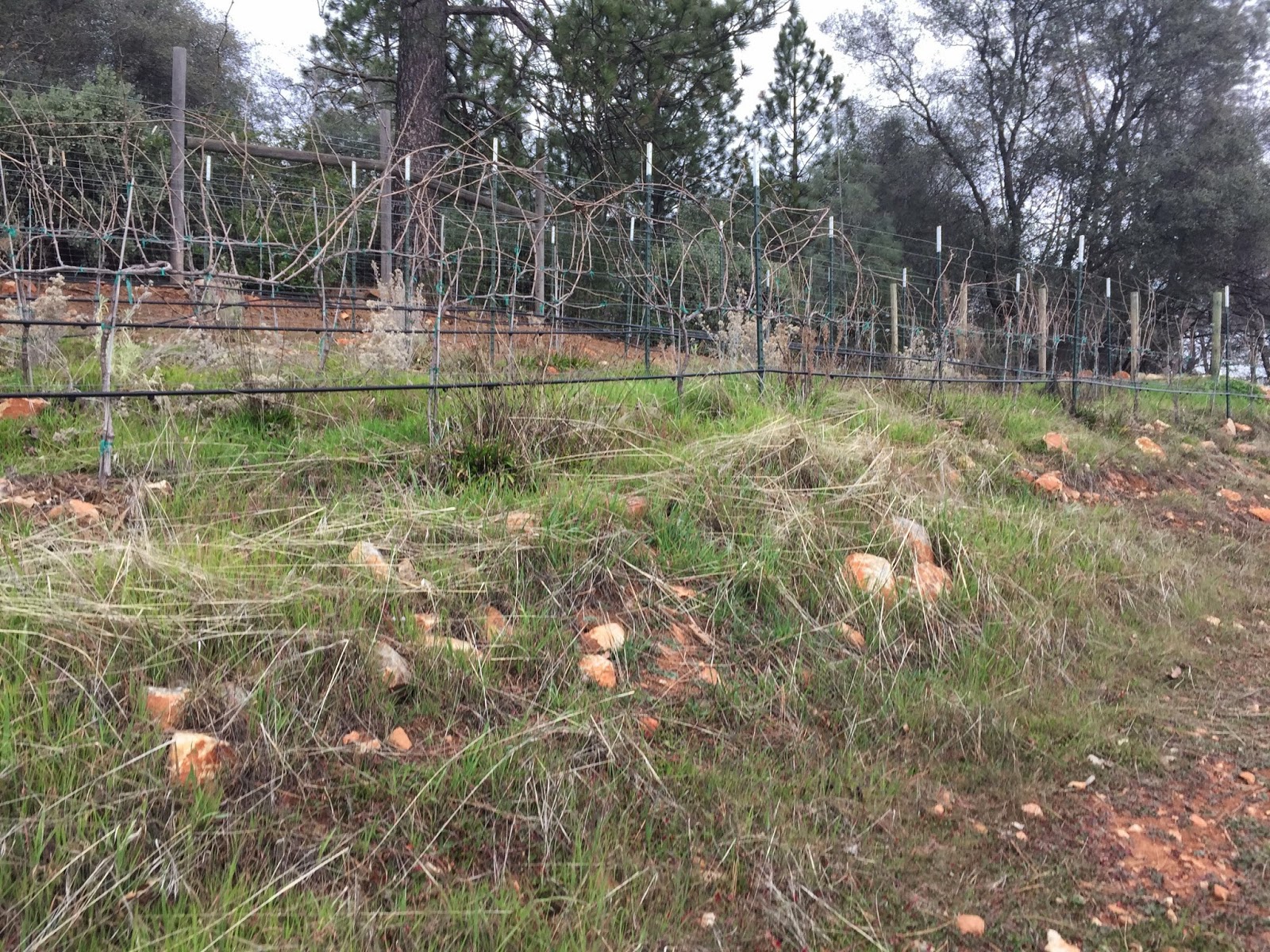
The plantings at Clos Saron are small, though undergoing expansion. The new, young vines take time to develop as they are ungrafted - therefore not receiving the high vigour of American rootstocks - and the phylloxera-free soil is difficult and infertile. Despite this and the ongoing drought, the young vines are watered just four times a year, while the older Pinot Noir vines from the 1970s haven't been watered in four years. With sheep grazing in the vineyards and ducks, geese, rabbits, and vegetables serving as food, Clos Saron is a largely self-sustaining farm - Gideon may be sceptical of the notion of the natural wine, but it's no surprise that supporters of the movement have tried to herald him as a leading light.

the wines

2014 Stone Soup Vineyard Syrah

young Viognier vines
From eleven-year-old vines planted on a steep, difficult, rocky southern-facing slope exposed to the sun, I feel this is one of those rare wines that will over time compare to the great wines of northern Rhône. Viognier vines have also been planted in the same vineyard, which will begin to be co-fermented with the Syrah. The vineyard is still a work in progress but the wine is one to watch out for: an intense perfume with great, dry, gripping tannins, and a winning combination of power and finesse.

2011 Old Block Pinot Noir ($75)

From ungrafted, phylloxera-free vines is Clos Saron's most intense, expressive, and developed wine. It's a young and intense, earthy wine, with wild strawberries on the nose. It has a beautiful mouthfeel, with elegant dry tannins and complex red berry fruits, flowers, pepper, and spices. A difficult wine that may take some years to express itself fully, but one whose intensity and closed structure mark it out from even many of the other best Californian Pinots.

the thick vines are older, from the 1970s; the thinner ones from the 1990s

As at any winery, tasting the wines from these two producers was a mixed bag (especially as so many of them were still in the barrel developing), but constant throughout was a willingness to experiment and a profound ambition to express the nature of the land. There was also a healthy scepticism towards the idea of natural as well as commercial wine: these were two winemakers doing their own thing rather than following any movement.

I think as the wines age, the differences between them and more standard wines will become less noticeable - instead the character of the wines, rather than the winemaking philosophy, will express itself further. However, the lack of sulphites and general intervention may cause difficulties: Gideon admitted that his wines had not shown well in France and the UK unless they had been given a month to settle. These are sometimes difficult and particular wines but ones that deserve respect - no less than any wine should.